 H T Mould China Limited
H T Mould China Limited
H T Mould China Limited
In the fast-growing market for fruit tea and large fruit-bucket drinks, packaging efficiency and appearance quality directly affect brand competitiveness. When daily demand reaches about 54,500 pieces, Maintenanceing molding quality for a 1000 ml large-capacity product while supporting both in-mold labeling (IML) and non-labeling production becomes a major mold-design and process challenge. This article uses the 119-1000 fruit bucket mold as an example to explain the 6-cavity solution, the 9.5-second cycle without labeling, the 12-second cycle with IML, and the key production parameters and optimization experience behind actual mass production.
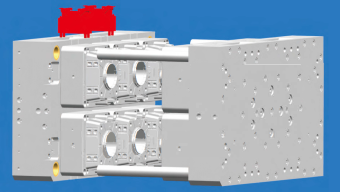
In recent years, serving sizes for fruit tea and similar beverages have continued to increase, and 1000 ml (1 liter) fruit buckets have become a bestseller for chain beverage brands. This type of container usually needs to meet the following requirements:
Highly transparent or translucent PP material to display fruit particles;
Large volume, but the wall thickness needs to be uniform to avoid shrinkage marks;
In-mold labeling is possible to enhance brand recognition and reduce subsequent labeling processes;
High daily output to match the high-speed operation of the filling line.
The target production capacity proposed by the customer is: 24-hour continuous production, with a daily output of approximately 54,500 pieces. Calculated based on a 6-cavity mold, the theoretical cycle needs to be controlled within 11 seconds (including action time). After evaluation, two sets of plans were finally determined:
Non-labeling production: target cycle time is 9.5 seconds;
In-mold labeling production: target cycle time is 12 seconds.
| Item | Parameter |
|---|---|
| Mold model | 119-1000 fruit bucket mold |
| Number of molding cavities | 6 cavities |
| Mold size | 650×1110×652 mm |
| Suitable for injection molding machines | 400 tons (clamping force) |
| Product volume | 1000ml |
| Main materials | PP (melting temperature 310℃) |
The 6-cavity layout adopts a "2×3" arrangement to ensure a reasonable projection area of the mold on the 400T machine, while leaving space for the robot to pick up and label.
A mixing solution of hot runner + cold runner short nozzle is adopted. The hot runner is responsible for balancing the pressure and temperature of the 6 cavities. The cold runner short nozzle reduces the length of the material head and the proportion of returned material. After mold flow analysis and optimization, the difference in filling time of each cavity is controlled within 3%, effectively ensuring the weight consistency of the six barrels (±0.5g).
| cooling project | parameter |
|---|---|
| Cooling water temperature | 18-22℃ |
| cooling water pressure | 0.5-0.6 Mpa |
| waterway design | Conformable waterway + partition type waterway |
Due to the high height of the fruit barrel (approximately 160-180mm), it is difficult for the traditional straight-line waterway to efficiently cool the middle part of the barrel. The design adopts 3D conformal water channels, arranges annular water channels along the contour of the barrel, and combines spiral partitions to enhance bottom and mouth cooling. The actual temperature measurement shows that the maximum temperature difference of the barrel is ≤5℃, and the cooling time accounts for about 50% of the total cycle.
| process | time |
|---|---|
| Mold clamping and locking | 1.2 seconds |
| Injection + pressure holding | 1.8 seconds |
| Cooling time | 4.5 seconds |
| Mold opening | 0.8 seconds |
| Product ejection and robot removal | 1.2 seconds |
| total cycle | 9.5 seconds |
When not labeling, the robot is only responsible for taking out the product and does not need to wait for the labeling action. At this time, the injection molding machine moves tightly, requiring smooth mold ejection and a robot pick-up speed ≥ 2.5m/s.
Key challenge: The 9.5 second cycle has extremely high cooling requirements. The PP material is injected at 310°C, and the surface of the mold cavity needs to be quickly lowered to about 40-50°C for demoulding. High heat exchange rate is achieved through 18℃ cooling water + large flow rate (0.5-0.6Mpa). At the same time, it is necessary to avoid deformation of the barrel mouth - for this reason, a reinforced annular cooling channel is added to the barrel mouth.
| process | time |
|---|---|
| Labeling before mold closing | 1.8 seconds |
| Mold clamping and locking | 1.2 seconds |
| Injection + pressure holding | 1.8 seconds |
| Cooling time | 5.5 seconds |
| Mold opening | 0.8 seconds |
| Remove product + label together | 0.9 seconds |
| total cycle | 12.0 seconds |
Difficulties in label positioning: The labels of the 6 cavities must accurately cover the trademark area of the barrel body and cannot be warped. The solution is to design small vacuum adsorption holes at the corresponding positions of the fixed mold cavity. The label will be automatically sucked after it is placed. During injection molding, the PP melt will heat-melt the label on the surface.
| parameter | set value | effect |
|---|---|---|
| Barrel temperature | 310℃ | Ensure the fluidity of PP and fill a 1000ml vat |
| Mold temperature (moving mold) | 28-32℃ | Balance crystallinity and improve transparency |
| Mold temperature (fixed mold) | 35-40℃ (when labeling) | Conducive to label fusion |
| Injection pressure | 85-105 MPa | Fast filling to avoid weld marks |
| Holding pressure | 50-65 MPa, holding pressure 2.0 seconds | Prevent sink marks, especially in thick-walled areas at the bottom |
| back pressure | 8-12 MPa | Improve plasticization uniformity |
| Cooling water temperature | 18-22℃ | Stable heat exchange |
| cooling water pressure | 0.55 MPa (recommended) | Guaranteed flow rate ≥25L/min per circuit |
Special note: During labeling, due to the thermal resistance between the label (usually PP or PET) and the melt, it is necessary to increase the fixed mold temperature to about 38°C and extend the cooling for 0.5-1 seconds, otherwise the edge of the label is prone to "halo" or warping.
Record of continuous operation for 72 hours:
| production mode | average period | Daily output | Yield | Major bad |
|---|---|---|---|---|
| No labeling mode | 9.47 seconds | 55,200 pieces | 98.3% | Trace amounts of burrs and cold material spots on the barrel mouth |
| In-mold labeling mode | 12.05 seconds | 43,200 | 96.8% | Label offset, label bubble |
Taken together, customers can flexibly switch according to order requirements: high-end customized fruit tea adopts the labeling mode, and ordinary promotional models adopt the non-labeling + external shrink label.
Economic benefits: Calculated based on 300 production days per year and 24-hour continuous operation:
Annual output without labeling: 16.56 million pieces;
Annual labeling output: 12.96 million pieces.
Each labeling barrel saves about $0.0116 in labor and material costs compared with post-labeling, and saves about $149,030.36 a year, covering the additional investment in IML molds.
| Problem phenomenon | reason | solution |
|---|---|---|
| There are obvious weld marks on the barrel body | The flow in 6 chambers is unbalanced and the injection speed is too slow. | Increase the injection speed to above 80mm/s, and adjust the hot runner temperature independently |
| In-mold label wrinkling | Insufficient vacuum adsorption, labels become damp | Vacuum holes φ0.5mm/6 per cavity, storage humidity <50% |
| The barrel mouth is oval when ejected | Uneven cooling and excessive ejection force | Optimized cooling water channel, 8 φ6mm ejector pins are dispersed and ejected |
Through 6-cavity high cavity count, optimized conformal cooling and precise timing control, the 119-1000 fruit bucket mold has successfully achieved stable production of 9.5 seconds without labeling and 12 seconds with in-mold labeling, with a maximum daily output of 55,200 pieces. This case proves:
Large-volume thin-walled containers (1000ml, wall thickness 0.8-1.2mm) can achieve a production cycle close to that of small cups through high-cavity molds;
In-mold labeling increases the cycle time by about 25%, but the overall cost is lower and the added value of the product is increased;
Conformal cooling + low-temperature cooling water is the key to high efficiency. Controlling the mold temperature below 30°C can shorten the cooling time by more than 15%.
In the future, with the increase in the speed of automated manipulators (such as six-axis collaborative robots) and the application of rapid mold change systems, the labeling cycle is expected to be compressed to 10.5 seconds, and the non-labeling cycle will be within 8 seconds, bringing the production cost of a 1000ml fruit bucket closer to the level of a 500ml cup.
This case has been successfully applied to three leading tea packaging material suppliers in China and exported to the Southeast Asian market, providing a reusable technical template for the mold design of large fruit tea buckets.
| project | No labeling | In-mold labeling |
|---|---|---|
| cycle | 9.5 seconds | 12.0 seconds |
| Daily output | 54,500 pieces | 43,200 |
| Mold temperature (fixed mold) | 30℃ | 38℃ |
| Cooling time | 4.5 seconds | 5.5 seconds |
| Yield | 98.3% | 96.8% |
Note: The actual output is affected by the stability of the injection molding machine, ambient temperature and raw material batches. It is recommended to conduct DOE test design before the first mass production.